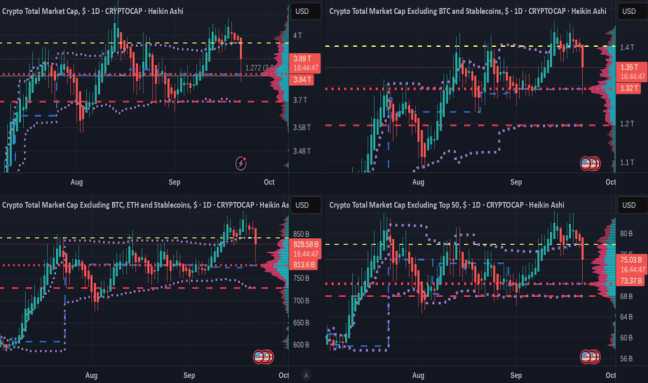
ETH COULD SEE 26% DECLINE EVEN AS EXCHANGE BALANCES HIT 2015 LOW
Ethereum Price Eyes $3,030 as Downside Risk Emerges
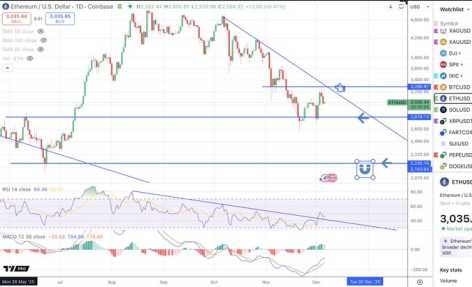
Ethereum is trading around $3,030 after failing to break through a strong sell-wall near $3,100. Analysts highlight the risk of insufficient buyer pressure above $3,000, suggesting a potential 26% decline toward $2,230 if the current support fails.
On-chain data, however, shows a historically low exchange supply of ETH—the lowest across major exchanges since 2015—indicating that strong selling pressure may be limited.
Derivatives markets reveal a tense balance between long and short positions. According to traders, even a 10% pump or dump could trigger nearly equal volumes of futures liquidations, reflecting heightened market sensitivity.
Key Resistance and Support Levels
Ethereum faces critical resistance around $3,285. Technical analyst Crypto Damus notes that a decisive break above this level would be necessary for a bullish shift.
On the downside, the $2,830–$2,900 support range is holding for now, but the chart shows a series of lower highs, signaling that sellers still dominate. If support breaks, $2,230 becomes the next major target.
Momentum indicators support this cautious outlook. The RSI remains in a downtrend, indicating buyers have yet to regain control. Overall, Ethereum remains in a delicate position, with a tug-of-war between potential upside and significant downside risk.
Ethereum Faces Massive Long and Short Liquidations as Bulls and Bears Battle
Ethereum (ETH) is hovering around $3,030, with the market showing extreme sensitivity to price swings, according to crypto trader Ted Pillows. His liquidation map highlights how fragile ETH’s current position is, suggesting that a 10% move in either direction could trigger billions in leveraged liquidations.
If ETH rallies, a 10% upward move would hit a significant cluster of short positions worth about $3.1 billion, primarily in the $3,300–$3,400 zone. Buyers pushing the price into this range could trigger a rapid short squeeze, forcing short sellers to cover their positions quickly.
On the downside, the risk is even larger. Roughly $3.57 billion in long positions would be liquidated if ETH drops by 10%. Long leverage is heavily concentrated in the $2,700–$2,800 range, meaning a decline into this zone could accelerate selling pressure and drive a sharper downturn.
Overall, Ethereum is caught in a high-stakes tug-of-war between bulls and bears, with both sides exposed to massive liquidation risks that could amplify volatility in the near term.
BITCOIN AND ETHEREUM MARKET OVERVIEW AND TECHNICAL ANALYSIS
Ethereum in a Tight Spot Amid Extreme Leverage and Low Exchange Balances
Ethereum (ETH) is currently in a delicate position. With heavy leverage on both sides, neither bulls nor bears have enough control to decisively move the market. When this balance eventually breaks, the resulting move is likely to be sharp—whether it triggers a long liquidation or a short squeeze first.
ETH Exchange Balances Hit Lowest Levels Since 2015
Blockchain data from Glassnode shows that the amount of Ether held on centralized exchanges has dropped to levels not seen since 2015. This decline indicates a tightening supply, as more ETH moves into long-term storage rather than remaining available for active trading.
At the time of writing, only 8.8% of ETH is held on exchanges, marking a 43% decrease since early July. This trend coincides with increased activity in digital asset treasuries, staking, restaking, layer-2 networks, decentralized asset token (DAT) purchases, collateral loops, and long-term custody solutions. All these factors are absorbing supply, leaving fewer coins available for active trading.
BITCOIN ETFS LOSE $3.5B IN NOVEMBER; IS THE MARKET BRACING FOR MORE BTC DOWNSIDE?
With fewer ETH available on exchanges, the market is now more sensitive to price swings. Any surge in demand could create a supply squeeze, potentially triggering a sharp move in either direction.
In short, Ethereum’s current setup—with extreme leverage and historically low exchange balances—sets the stage for heightened volatility, making the next market move particularly significant.
Conclusion
Ethereum is currently navigating a highly sensitive market environment. Heavy leverage on both sides, combined with historically low exchange balances—the lowest since 2015—creates a setup for significant volatility. While bullish and bearish forces are evenly matched, any decisive move could trigger a sharp long liquidation or short squeeze.
At the same time, reduced ETH supply on exchanges and increased activity in staking, layer-2 networks, and long-term custody suggest that liquidity is tightening. This makes Ethereum highly responsive to market catalysts, meaning even modest demand shifts could lead to large price swings.
Overall, ETH’s current position highlights both risk and opportunity, with traders needing to watch key resistance and support levels closely while keeping an eye on market leverage and supply dynamics.