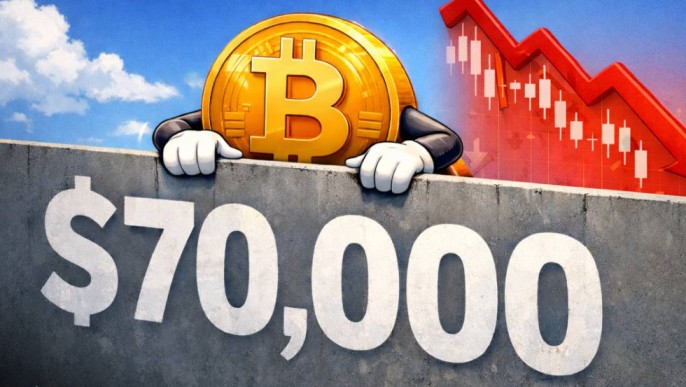
INVESTORS WITHDRAW $2.7B AS BLACKROCK BITCOIN ETF HITS LONGEST OUTFLOW TREND
BlackRock’s iShares Bitcoin Trust just recorded its toughest month yet — in fact, every previous month has performed better. After a disappointing November, the world’s largest Bitcoin ETF is now facing a six-week streak of outflows that signals waning investor confidence. Once viewed as a key link between traditional finance and the crypto market, BlackRock’s iShares Bitcoin Trust (IBIT) is now reflecting a noticeable drop in enthusiasm.
According to Bloomberg, more than $2.7 billion exited the fund over the five weeks ending November 28, followed by an additional $113 million in withdrawals on Thursday, December 4.
A DEEPER SHIFT BEHIND BITCOIN’S DECLINE
Bitcoin’s recent downturn highlights a broader change in market behavior. As the cryptocurrency slides into a bear phase and retail enthusiasm fades, even institutions—once seen as the industry’s stabilizing backbone—appear to be pulling back.
BlackRock’s IBIT is now facing its longest stretch of withdrawals since launching in January 2024, a sharp contrast to the strong inflows that earlier helped drive Bitcoin to new all-time highs.
Despite holding more than $71 billion in assets, overall sentiment remains noticeably cautious across trading desks.
FactSet data indicates that investors pulled $2.2 billion from the ETF in the weeks before Thanksgiving — nearly eight times October’s outflows and the largest monthly decline in the product’s history.
And while Bitcoin has shown brief signs of stabilization, withdrawals from IBIT haven’t slowed, signaling a clear shift toward risk-off positioning.
Bitcoin’s own performance is also weighing on confidence. Trading near $88,900, the asset is down 8.5% year-to-date, a stark contrast to the S&P 500’s 16% gain in 2025.
SOLANA MOBILE ANNOUNCES JANUARY RELEASE FOR SKR TOKEN
Bloomberg data shows this is the first time since 2014 that U.S. equities have posted strong gains while Bitcoin has simultaneously declined.
A “Trump boom”? Not quite
The wider crypto market has lost more than $1 trillion in value since a sharp liquidation wave in early October set off an extended downturn. Retail investors—who grew used to the rapid gains seen in early 2024—have been far less able to weather the decline.
Institutions may have deeper pockets, but the persistent outflows show that many are also choosing to step back rather than ride out the volatility.
ETHEREUM ETF OUTFLOWS HIT $75.21M WHILE ETH PRICE FLATLINES AT $3K
As for the political narrative, the long-anticipated “Trump boom” for digital assets has yet to appear.
Bitcoin did climb above $126,000 earlier this year, but the steep correction that followed has forced the industry to rethink expectations around regulatory changes and institutional participation.
SkyBridge founder Anthony Scaramucci summed it up bluntly on his podcast, The Rest Is Politics:
Trump, being Trump, launches two meme coins on the eve of the election. One for him and one for Melania, right? So meme coins are just like gambling tokens. They have very little value. These meme coins go up in value. He takes [$500] or $600 million out for himself and his family. And these meme coins over the last seven or eight months have crashed in value… It’s just going to be a huge problem for the industry because if you have a president that’s running a self-interested memecoin, which is a worthless token, he’s susceptible to grift and graft. He’s susceptible to people buying the token and then trying to influence him. And lo and behold, Trump says, “Yeah, go buy my token or make a $5 million donation to me, and I’ll meet you, crypto people, at my Virginia country club.” And so what this did was it soured the industry. It had the opposite effect.
Bitcoin breaks from its usual market patterns
In a twist few expected, Bitcoin’s long-standing correlation with risk assets has faded. AI-related stocks are soaring, and gold is nearing record levels—yet Bitcoin continues to move in the opposite direction, following its own notably weaker trend.
This raises an important question: Are the outflows from BlackRock’s ETF merely a temporary setback, or an early signal of a more challenging 2026 ahead?