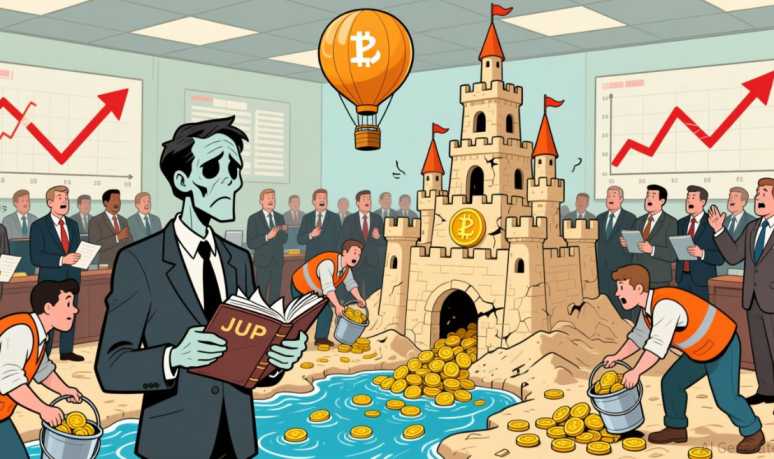
JUP PRICE UNCHANGED AFTER $70M BUYBACK, SAYS SOLANA CO-FOUNDER
Jupiter’s token debate has revived a long-standing question in the crypto industry: can buybacks really support prices when token supply continues to grow?
In Jupiter’s case, the buyback program was not large enough to absorb the steady flow of new JUP tokens entering the market, limiting its impact on price performance.
The discussion resurfaced in early January following remarks by Siong Ong, co-founder of Jupiter. It gained further traction after Solana co-founder Anatoly Yakovenko shared his perspective, sparking a broader debate about whether token buybacks are effective in crypto projects with high token emissions.
Buybacks Outpaced by Token Unlocks
Jupiter allocated roughly half of its protocol fee revenue to buy back JUP, spending more than $70 million throughout 2025. On the surface, the effort looked substantial. However, market performance told a different story. By early January 2026, JUP was trading around $0.20–$0.22, down nearly 89% from its all-time high.
Supply Growth Drives Price Pressure
The decline was not due to weak platform usage. Jupiter continued to process billions of transactions and remained one of the most active DeFi platforms on the Solana blockchain. Instead, the key issue was rapid supply expansion. Since launch, JUP’s circulating supply has grown by roughly 150%, while the buyback program absorbed only a small portion of newly unlocked tokens.
Ongoing Unlocks Limit Buyback Impact
Token unlocks are occurring on a fixed schedule, regardless of market conditions. Through June 2026, around 53 million JUP tokens are set to unlock each month, creating steady sell pressure even as the protocol continues to perform well.
Shift Toward Growth Incentives
Under these conditions, buybacks have acted more as a short-term cushion than a lasting source of price support. Jupiter co-founder Siong Ong acknowledged this reality, noting that continued buybacks may not be the most efficient use of capital. Instead, he suggested redirecting resources toward growth-focused incentives to strengthen the ecosystem over the long term.
SKYBRIDGE CEO NAMES SOLANA, AVALANCHE, TON AS LEADING ALTCOIN BETS FOR 2026
Yakovenko’s Take on Why Buybacks Miss the Mark
Solana co-founder Anatoly Yakovenko explained the issue in straightforward terms. In markets with heavy token emissions, short-term buybacks do little to change how sellers price risk. Tokens unlocked today are typically sold at current market prices, not at a higher future value suggested by ongoing repurchase programs.
A Time-Based Alternative to Buybacks
Instead of immediate buybacks, Yakovenko suggested that protocols could accumulate profits and deploy them at a later stage. Another option is introducing staking programs with longer lockup periods. These approaches shift how unlocks are valued, tying them to a future, post-buyback environment rather than short-term market demand.
Encouraging Long-Term Thinking
Such strategies also encourage token holders to think in longer cycles, similar to how balance sheets are managed in traditional finance. This perspective contrasts with short-term trading behavior driven by frequent unlocks and immediate liquidity.
Mixed Community Response
Reactions within the Jupiter community have been divided. Some argue that buybacks are still important for maintaining discipline and aligning incentives. Others believe their effectiveness diminishes when supply growth remains aggressive.
Adjustments to Jupiter’s Token Strategy
Jupiter has already begun to adjust its approach. The project reduced its planned 2026 airdrop allocation from 700 million to 200 million JUP, signaling a shift in token strategy. The takeaway is becoming clear: in token models dominated by large unlocks, buybacks alone are unlikely to meaningfully alter price outcomes.
BITCOIN PRICE OUTLOOK: TOUGH Q4 WRAPS UP AS ANALYSTS PROJECT $80K–$140K RANGE IN 2026